A hydraulic rock drill broke open the final meter of rock beneath the Alps on Thursday, connecting Austria and Italy nearly 4,600 feet underground — marking a historic milestone in one of Europe’s largest transport undertakings.
The event celebrated the near completion of the Brenner Base Tunnel, a core link in the EU’s trans-European transport network (TEN-T) that will one day enable high-speed rail travel from Helsinki to Palermo.
At the ceremony, Italian Premier Giorgia Meloni and Austrian Chancellor Christian Stocker hailed the achievement as a symbol of European cooperation.
“There is no project too big to be tackled, no challenge too ambitious,” said Meloni. “This tunnel represents a shared vision for a faster, greener Europe.”
When completed in 2032, the Brenner Base Tunnel will be the longest underground rail tunnel in the world, forming part of a wave of Italian infrastructure projects that promise to cut travel times, reduce emissions, and strengthen EU integration.
Revolutionizing Travel and Trade
These projects — co-funded by the European Union, Italy, and Austria or France, among others — will reshape both passenger mobility and freight logistics across the continent.
Travel time between Verona and Munich will drop by more than half to 2.5 hours, while the Milan–Paris route will shrink to 4.5 hours. The Genoa–Milan connection will make the Ligurian port city commutable from Italy’s financial hub, transforming regional accessibility.
More importantly, the shift from road to rail will help remove millions of trucks from highways, cutting congestion, pollution, and noise along critical corridors such as the Brenner Pass, where 2.5 million trucks currently cross each year, carrying over $824 billion in goods.
“Air quality will improve, noise will diminish, and CO₂ emissions will fall,” said Apostolos Tzitzikostas, European Commissioner for Sustainable Transport and Tourism.
Four Projects Powering Italy’s Future Mobility
1. Brenner Base Tunnel
- Length: 34 miles (40 miles including connecting tunnels)
- Cost: $10.5 billion
- Timeline: Completion by 2031, trains operational by 2032
- Funding: Italy, Austria, and the EU
- Impact: Will halve travel time between Verona and Munich, removing significant freight from Alpine highways.
2. Tortona–Genoa High-Speed Rail Line
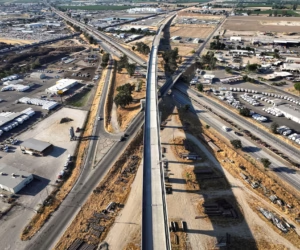
- Length: 33 miles, including 23 miles of tunnels
- Cost: $10 billion
- Status: 90% complete, operational by 2026
- Impact: Reduces Milan–Genoa travel to 1 hour; shifts port freight from road to rail, targeting 50% by 2050.
3. Lyon–Turin Rail Tunnel
- Length: Over 40 miles (36 miles underground)
- Cost: $13 billion
- Funding: France, Italy, EU
- Timeline: Completion expected by 2032–2033
- Impact: Removes 1 million trucks annually from Alpine roads; cuts Paris–Milan travel to 4.5 hours.
4. Strait of Messina Bridge
- Cost: $16 billion
- Design: Single-span bridge linking Sicily (Messina) and mainland Italy (Calabria)
- Features: Six car lanes, two rail lines
- Timeline: Final approval pending; completion expected by 2032
- Impact: Provides Italy’s first-ever fixed link to Sicily, integrating southern routes with the national rail grid.
Building a Sustainable Future
The Italian government and the EU see these megaprojects as cornerstones of Europe’s sustainable transport strategy, aiming to shift freight from road to rail, cut travel times, and strengthen cross-border links.
Many are being financed through nearly $30 billion in EU Recovery and Resilience Funds, which prioritize green, digital, and resilient infrastructure.
“The challenge of construction gives extraordinary satisfaction,” said Pietro Salini, CEO of Webuild, the Italian construction giant leading all four projects. “It changes people’s lives and shapes the future of mobility.”
Together, these transformative efforts mark the most significant upgrade to Italy’s transport network since the Rome–Milan high-speed line launched in 2008 — signaling a new chapter in how Europe connects, travels, and trades.