


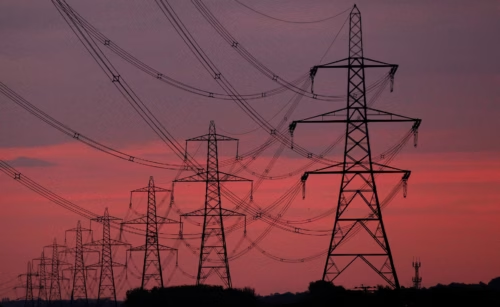
A sustained programme of ambitious UK electricity grid investment could unlock £194 billion in economic benefits, support tens of thousands of jobs, and strengthen national energy security by 2040, according to a major new study by engineering and sustainability consultancy Arup.
The macroeconomic report, Gridunlocked: Unlocking the benefits of investing in the electricity grid, finds that investing £34 billion over the next 15 years would deliver a four-to-one return on investment, provided funding for grid modernisation is maintained at scale.
Jobs and growth across the UK economy
By modelling two scenarios — an “underpowered” investment pathway and a more ambitious “supercharged” approach — the study concludes that sustained grid investment could support an additional 92,000 jobs every year through to 2040.
The benefits would be felt across a wide range of sectors, including:
- Services, which could grow by £95bn, supporting 68,000 jobs annually
- Property, with growth of £33bn
- Construction, adding £20bn to the economy
Many of the roles created would be high-skill, high-value jobs, with strong potential to boost long-term workforce development and productivity.
Supporting the energy transition and energy security
Conducted in collaboration with Cambridge Econometrics, the study highlights that the impact of UK electricity grid investment extends well beyond economic growth.
A modernised, well-funded grid would allow the UK to:
- Better support the transition to low-carbon electricity
- Keep pace with rising demand from electrified homes, transport, and industry
- Reduce reliance on unabated gas
- Protect consumers and businesses from global energy price volatility
The report argues that grid investment is a critical enabler of a more resilient, decentralised, and flexible energy system, particularly when paired with digitalisation to improve network stability and responsiveness.
Call for coordinated, whole-system planning
However, Arup cautions that grid funding alone is not enough. To unlock the full benefits of investment, the report calls for a joined-up, programmatic approach across the entire energy system — spanning generation, storage, transmission, distribution, and demand-side flexibility.
Strategic coordination is needed across:
- Policy and regulation
- Finance and investment planning
- Technical design and delivery
- Supply chains and skills
- Community engagement
Early and meaningful involvement of local communities is highlighted as essential to building trust and ensuring that infrastructure development reflects public priorities.
Industry leaders respond
Mark Neller, Energy Leader for Arup in the UK, India, Middle East and Africa, said the findings underline the scale of opportunity:
“Our research shows that ambitious grid investment is a catalyst for economic growth, job creation, and energy security. The choices we make today will determine the pace and success of the UK’s energy transition. Unlocking the benefits depends as much on how we deliver as on what we invest.”
Juergen Maier, Chair of Great British Energy, added:
“Expanding electrification across UK homes, industry and businesses is essential to cutting bills, lowering emissions, and improving energy efficiency. The Gridunlocked report by Arup helps to show what can be achieved by working in partnership, delivering significant investment for long-term grid security.”
Global relevance beyond the UK
While the study focuses on the UK, Arup notes that many of its conclusions are internationally applicable. If adopted elsewhere, the recommendations could help accelerate the global transition towards net zero energy systems.
Read the full Arup Gridunlocked report: https://www.arup.com/campaigns/gridunlocked/


